Saturday, December 27, 2014

Traditional Treatment Methods for Diabetes

Traditional Treatment Methods for Diabetes
 
The American Diabetes Association estimates that diabetes accounts for over 100,000 deaths, 54,000 amputations, and over 20,000 cases of blindness each year. Blindness is twenty-five times more common among diabetic patients when compared to those without diabetes. If these current trends should continue, then by the year 2010 diabetes will exceed both heart disease and cancer as the leading cause of death in America.
Diabetics tend to have a high level of blood glucose. Blood sugar level is regulated by insulin, which releases it to carbohydrate consumption. Insulin causes the cells of the body to absorb glucose from the blood. The glucose is then used as fuel for cellular functions.
Traditional diagnostic standards for diabetes have been plasma glucose levels greater than 140 milligrams on 2 occasions as well as plasma glucose greater than 200 milligrams following a 75 gram glucose load. Even more recently, the American Diabetes Association lowered the criteria for a diabetic diagnosis to plasma glucose levels equal to or greater than 126 milligrams. Plasma levels outside the normal limit will need further testing. This is done usually by repeating the plasma glucose check and initiating an oral glucose tolerance test if it is needed.
The many symptoms of diabetes include increased urination, increased thirst and hunger, sudden drastic weight loss, blurred vision, very slow healing of wounds, dry and itchy skin, constantly repeated infections, sudden fatigue and headaches. With respect to diabetes, these symptoms can also be caused by many other factors. It is highly encouraged that anyone with symptoms related to the ones mentioned above should be tested as soon as possible.
A very easy tip for diabetics to remember is exercise will cause your body to process glucose a lot faster and automatically lower blood sugar. The more intense the exercise, the faster your body will use glucose. It is always important to understand the differences in exercising with diabetes. It is also important for the individual who has diabetes to check with a physician before beginning an exercise program.
When training with a diabetic person, you must always take into consideration the dangers of injecting insulin before working out. An individual with type I diabetes who is injecting their normal amount of insulin before exercise, can pose the risk of hypoglycemia or insulin shock.
General exercise rules for type I diabetics are the following:
1) Allow adequate rest during exercise to prevent high blood pressure.
2) Use low impact exercises and avoid heavy weight lifting.
3) Always have food with a lot of carbohydrates ready.
If blood sugar levels get too low, the individual may feel shaky, disoriented, hungry, and become highly irritable. Consuming a carbohydrate snack or beverage will terminate these symptoms in a short period of time.
Before using an exercise plan, it is always important for blood sugar levels to be tested. Make sure that they are between 100 and 250 milligrams. Glucose levels should also be tested before, during, and after exercise or any strenuous physical activity. During their recovery period, it is important for diabetics to consume high carbohydrates in order to prevent hypoglycemia.
Exercise will greatly benefit an individual specifically with type 2 diabetes. This is due to the positive effects on insulin sensitivity. Proper exercise and nutrition are by far the best forms of prevention for type 2 diabetics. To prevent hypoglycemia, continuously work up to more active exercises.

For more important health articles visit Donald's Health Website. http://updated-health-news.blogspot.com

ARTICLE FROM :  www.articleworld.net

Thursday, April 17, 2014

Surprising Health Benefits of Sex

Sunday, February 16, 2014

Stroke Risk May Persist Longer Than Thought After Childbirth

By Kathleen Doheny
HealthDay Reporter

THURSDAY, Feb. 13, 2014 (HealthDay News) -- The increased risk of having a stroke or other blood-clotting problem might continue longer after a woman gives birth than previously believed, according to a new study.
"Historically, six weeks was the accepted period," said study researcher Dr. Hooman Kamel.
"We found the risk of blood clots remained higher than normal for twice as long as previously thought. After 12 weeks, it was no longer significant," said Kamel, an assistant professor in the Weill Cornell Medical College department of neurology and the Feil Family Brain and Mind Research Institute.
Even though the elevated risk continues for longer than previously believed, Kamel stressed that the overall risk is still low.
The study was published online Feb. 13 in the New England Journal of Medicine. Kamel, who is also a neurologist at NewYork-Presbyterian Hospital, is presenting the study Thursday at an American Stroke Association meeting in San Diego.
Kamel and his team looked at medical information from nearly 1.7 million women in California giving birth to their first child. The women delivered between early 2005 and mid-2010. Through the first year and a half after delivery, about 1,000 of the women had clotting problems, including about 250 strokes, 50 heart attacks and more than 700 cases of venous thromboembolisms (clots in the legs or lungs).
"Just like prior studies, we found the risk of these types of blood clots during the first six weeks after birth was [more than] 10 times higher than normal," Kamel said.
In the seven to 12 weeks after delivery, the risk dropped to twice the normal rate, he said. After 12 weeks, the risk was the same as when the woman was not pregnant.
Doctors monitor women for blood clots during pregnancy because the blood clots more easily at that time, according to the American Society of Hematology.
The risk of clotting problems during pregnancy is increased in women who are obese or genetically predisposed to clots, according to the society. The risk also increases in women who are inactive, on prolonged bed rest or take long trips by plane or car.
Kamel said smokers and women with chronic high blood pressure are also at increased risk.
Doctors give high-risk women low-dose blood thinners for six weeks after delivery to reduce their risk, Kamel said. Future research should focus on whether 12 weeks would be a better timeframe for the drugs, he said.
The study was funded by the U.S. National Institute of Neurological Disorders and Stroke.
The findings suggest that both doctors and pregnant women should have a heightened awareness of the potential blood clot risk longer than the traditional six-week period, said Dr. Burton Rochelson, chief of maternal fetal medicine at North Shore LIJ Health System in Manhasset, N.Y.
Rochelson reviewed the findings but did not participate in the study. He, too, emphasized that although the increased risk was found to persist, the absolute risk is small. "Even though the risk increases in that seven to 12 weeks, you are still talking about very few people relative to the total number," he said.
Since the events are serious, however, "even a small number is undesirable," he said.
One study limitation, Rochelson said, is that the researchers combined all the blood-clotting problems. In future studies, he said, researchers should consider looking separately at the risks of heart attacks, strokes and blood clots in the legs and lungs.
Women should be aware of the warning signs of a blood clot problem, Kamel said. These include chest pain or pressure; difficulty breathing; pain or swelling in one leg; sudden and severe headache; or a sudden change in consciousness, speech, balance, strength or sensation on one side of the body.
View the original article here

Supportive Mate a Good Match for Your Heart

News Picture: Supportive Mate a Good Match for Your HeartBy Alan Mozes
By Alan Mozes
HealthDay Reporter

FRIDAY, Feb. 14, 2014 (HealthDay News) -- Every Valentine's Day, heart-shaped boxes filled with chocolates fly off the shelves as couples express their love for each other, but a new study suggests that a supportive spouse may be the real key to a happy and healthy heart.
A new investigation that combined CT scans with survey results revealed that people who feel their partner is always helpful in times of difficulty seemed to have lower levels of an early sign of heart disease. It's called "coronary artery calcification" -- a build-up of calcium in the artery walls.
By contrast, couples that viewed each other as unreliably "ambivalent" -- sometimes helpful, sometimes not -- tended to have higher levels of coronary artery calcification.
The study authors noted that their finding is preliminary, and will require much more follow-up before being able to draw a direct cause-and-effect link between coronary artery status and spousal support.
"It is certainly possible that part of the reason why ambivalent marriages are associated with greater cardiovascular risk is because of health behavior changes, such as smoking or exercise patterns" that shift when spousal support is found wanting, study author Bert Uchino acknowledged. "Having good-quality relationships are thought to increase our motivation to care for oneself, so having an ambivalent marriage may decrease one's motivation to eat healthy or exercise."
"However, we believe that this may only explain a very small part of what is going on, as we directly accounted for health behaviors and other indicators such as cholesterol levels, and our results still hold," Uchino said. "Thus, we believe that these results primarily reflect the stressful nature and lack of support when in a marriage where both parties view each other as ambivalent."
Uchino, a psychological scientist with the department of psychology and health psychology at the University of Utah, reported the findings this month in the online issue of Psychological Science.
The authors focused on 136 heterosexual couples in the Salt Lake City region. The average age for participants was 63, and the average length of marriage was about 36 years. None of the men or women had any history of heart disease, and nearly all (about 97 percent) were white.
All participants completed questionnaires to get a handle on perceptions regarding both overall marriage quality and spousal behavior at those times when one or the other felt they needed support, advice or a favor.
The result: Roughly 30 percent described their spouse was solidly supportive, while 70 percent felt responses to their requests for support were unpredictably helpful or upsetting, depending.
As for the physical findings, CT scans revealed that coronary artery calcification levels rose the most when two partners both felt ambivalent about the other's support.
Calcium build-up levels fell somewhat when just one spouse felt that way, while the best (lowest) scores were seen among those where neither felt ambivalent about support.
What's more, the connection held up regardless of how satisfied a spouse said he or she was with their overall marriage.
The exact way in which the perceived lack of reliable support affects heart health remains unclear, the team noted. But they suggested that it might have a negative impact on stress levels, in turn harming cardiovascular health.
American Heart Association spokesperson Dr. Nieca Goldberg suggested the findings were in line with what she would have expected.
"It's not a surprise to me," she noted, "given the other literature that has already been published in this field. Other studies have looked at how levels of social support in people with existing heart disease affect survival rates. And they found that there is a direct relationship between the number of people a patient has in his or her support network and the length of survival following a heart attack."
"But I'm really glad we're starting to explore this area more and more," added Goldberg, medical director of the women's heart program at NYU Langone Medical Center, in New York City. "Because there's been lots of research looking at connections between emotions and heart health. And sometimes they're not so definitive. But now we have a study finding a link with a major marker for coronary heart disease, calcification, together with older studies that saw a link between improved survival among heart attack patients who have more social support. So clearly there's something here."

View the original article here

This Is You On Stress

I was late to work. What if I lose my job? How will I find time to grocery shop? My family is going to starve. Could this headache mean I have cancer?
 
Even if your head doesn't spin with these exact worries when it hits the pillow at night, there's probably something similar whirring through your brain, keeping you up just when you should be powering down. As a psychiatrist and contributor to the Today show, I see many women who battle with anxieties, and not just at night. They obsess about their children, their marriage, their finances, their job, their parents; about sickness, accidents, disappointments and assorted other upsets that come under the heading Bad Things That Could Happen. This is the nature of anxiety—an unpleasant emotional experience caused by the unpredictability and uncontrollability of the future and the ways that it could hurt you.
We all experience anxiety. It's the mental part of fear, which is a biological response to a threat or danger. From an evolutionary perspective, fear is what has helped us humans survive for so long: It impels us to run away or hide if we see, say, a bear approaching. And if you are in a park known to have many bears, it's totally normal and logical to feel anxious even if you don't see one, because this makes you cautious and keeps you from leaving food out at your campsite. But what if you are at work and you start thinking about a camping trip you might take with your family and grow very worried that you could encounter a bear that might maul you or your kids, resulting in utter tragedy? This is when anxiety no longer serves a useful function and becomes a real problem—when you can't stop obsessing about the possibility of something terrible happening, no matter how small or remote it is.
Trying to have it all just adds to the anxiety many women feel. I hear frequently from Today watchers and my New York City-area patients that the burden of balancing a healthy relationship and turning out great kids while remaining financially afloat (and looking young and staying fit, of course) leaves them fried and fretting. A patient I'll call S.W. came in reporting that she was exhausted from waking up in the middle of the night concerned that she wouldn't get the next big project at work, her son wouldn't make the basketball team, her husband wouldn't get that raise and they wouldn't be able to afford a down payment on the house she wanted. Then, when she was awake, she felt little jolts of stress all over again. S.W. did not have an anxiety disorder per se but rather a normal, albeit hefty, dose of worry.
It is possible, though, to retrain an anxious brain. I helped S.W. learn how to lower both the frequency and the amplitude of her worry so she could sleep better and be much more productive during the day as a result—and you can learn how, too.
Why we worry
S.W.'s story isn't unique, nor is the fact that her husband doesn't tend to fret about this stuff: Believe it or not, it's partly because of the way women's brains are wired. A woman's limbic cortex—the area responsible for emotional processing—is larger on average than a man's, leaving more potential space for worry to live. Guys' brains also tend to produce more of the soothing neurotransmitter serotonin. Then there's the psychological impact of society's expectations for women. While, over the years, husbands have certainly stepped up the domestic duties they perform, women often still feel that they're responsible for the household. And while men may consider it a job well done if they've made an effort, we often stress out if we don't do every little thing flawlessly—from getting a balanced meal on the table to making sure our kids' hair is combed—even though perfection isn't always under our control. One group of worriers I see growing, in fact, is the smart and successful woman. She's juggling a lot, and she understands not only how many balls she has in the air but how many can drop. She may also worry about worrying so much, which makes her feel worse.
Think yourself oh-so-calm
This kind of stressing is normal, but it's not inevitable: There are things you can do to take the wind out of worry's sails. First, note that anxiety tends to be future-oriented (What if something happens?) and quickly escalates to the most dire of consequences (Then I'll be broke, divorced, homeless, dead). But is there really any evidence for these outcomes? Challenging your fears before they get very far prevents them from blowing out of proportion and keeps new ones from cropping up. Ask yourself, "Is this something that's about to happen or something that might happen in a faraway, imaginary future? Do I have any control over the outcome?" Try to take steps to manage what you can—finally setting up your 401(k) so you don't go broke, spending more one-on-one time with your spouse to remind yourself of your solid relationship. When thoughts pop up about things that you can't control, whether it's being laid off or widowed, say to yourself, "That's just my mind doing its worry shtick again." Then move on.
You should also take advantage of the mind-body connection. When you perceive danger, adrenaline surges through your body, which causes you to breathe faster and sweat harder. This reaction in the body feeds back to your mind, making you nervous and often leading your brain to invent dire outcomes that are unlikely to occur. Breaking that cycle can interrupt the worrisome thoughts. To do that, try slow, deep breathing for a few minutes each day or whenever you're freaking out. Put your hand over your abdomen and breathe in for a count of five, then out for five. Muscle relaxation also calms the body. Sitting in a quiet place, tighten each muscle group in your body—starting with your feet and working your way up to your head—for a count of five, then release. Or use visual imagery: Picture a beautiful and relaxing place you've been to or seen.
The truth is, life will never be worry-free. But if you learn how to wrangle your fears, you'll feel happier in the here and now, instead of spending your energy trying to detect a bear far, far down the road.
Get the latest health, fitness, anti-aging, and nutrition news, plus special offers, insights and updates from Health.com!
View the original article here

Sunday, December 8, 2013

13 Easy Recipes That Use Rotisserie Chicken


Quick chicken recipes


Ah, the rotisserie chicken. Who hasn't been tempted to buy one of these precooked birds? You can pick one up at almost any supermarket—usually for less money than a raw chicken the same size.

But just because you fall for ready-made convenience, doesn't mean you have to give up on home-cooking altogether. These recipes are perfect for those weeknights you don't have time to cook a chicken (ahem—every weeknight), but want to serve something a bit more interesting than plain ol' chicken.

Penne With Chicken and Preserved Lemon

Freshly shaved Parmesan pairs nicely with bitter greens and tangy lemon in this recipe for Penne With Chicken and Preserved Lemon.

Hoisin-Glazed Chicken With Sugar Snap Peas

Sick of ho-hum chicken? Try our Hoisin-Glazed Chicken With Sugar Snap Peas recipe. A flavor-packed glaze and quick-cooking snap peas make a quick, delicious dinner.
View the original article here

5 Fast, Fresh, and Fabulous Meals

Deliciously light dinners

By Adapted from Real Simple

Recipes by Kate Merker and Allison Fishman
You don't need a lot of prep time to make these mouthwatering meals.

Pork Tenderloin with Cabbage and Apple Slaw
In only 25 minutes, you’ll have this low-cal, yummy dish on the table. Pork provides quality, lean protein and is rich in an immune-boosting combo of B vitamins and zinc. Cabbage is a great source of vitamin C and folate, and apples provide cholesterol-lowering soluble fiber.

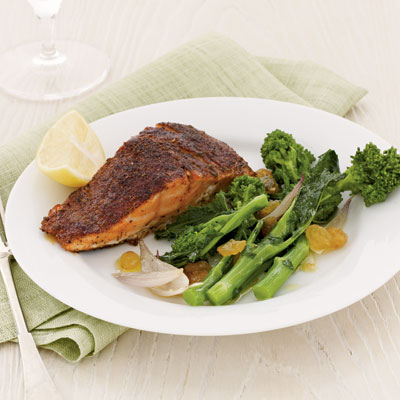
Blackened Salmon With Broccoli Rabe and Raisins

Just 20 minutes total gets you flavorful, omega-3-rich fish plus an amazing side dish. Broccoli rabe (or rapini) is a slightly bitter leafy-green vegetable that is high in vitamins A and C and also contains phytochemicals called indoles and sulforophanes believed to help fight cancer. Juicy, iron-rich raisins add a touch of sweetness to balance out the spicy salmon.  


Slow Cooker Chicken With Tarragon and Leeks 

You'll look forward to coming home to this tasty one-pot meal! It's full of tender chicken high in B vitamins like niacin, which aids in energy metabolism and keeps your skin healthy.

The creamy sauce gets it's flavor from fresh herbs and mild leeks, not an excess of sodium, while rich low-fat Greek yogurt adds depth without a load of saturated fat. Both new potatoes and peas provide fiber, the antioxidant vitamin C, and potassium, which helps regulate blood pressure.

Spaghetti With Quick Meat Sauce

Lean gound sirloin lightens up this family standard, and carrots pack it with fiber and beta carotene. Use whole-grain pasta to up the fiber even more. Round out the meal with a mixed green salad for added color and vitamins A and C—two powerful antioxidants that help fight heart disease.

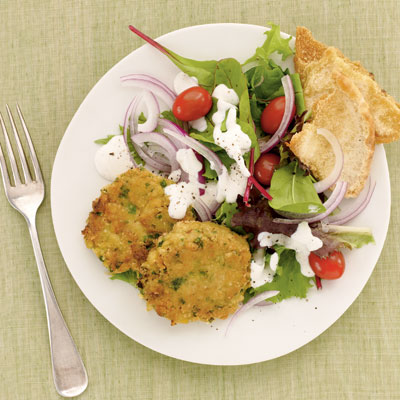
 Mediterranean Chickpea Patties


These healthy, falafel-style patties make a fabulous vegetarian main dish or a tasty side. Chickpeas are full of hunger-taming fiber and energy-boosting iron, while the tangy yogurt dressing adds rich flavor without the saturated fat


View the original article here